
Buy your cat a lovely bed and there's a good chance they'll sleep in the box it came in. Every cat owner knows the joke, and there's real cat behavior behind it.
A cardboard cat house takes that box and makes it a proper piece of cat furniture: a den to hide in, a roof to sit on and walls to scratch. But cardboard wears out, it hates water and some cats eat it. So is a cardboard house worth having? Here's what it does well, where it falls short and how to tell when it's time for a new one.
Quick answer
For most cats, yes. A cardboard cat house is a hideout, a scratcher and a napping spot in one, and cats love all three. The catch is that it wears out: replace it once it's soggy, wobbly or scratched through, and take it away from any cat who eats the cardboard rather than shredding it.
Why do cats love cardboard so much?
Nobody has asked a cat directly, but what we know about cat behavior gives some strong clues.
Here's how vet Dr Duncan Houston sums it up:
Dr Duncan's advice: Cardboard is crunchy, dry, scratchy and firm. Cats can claw and rip it and sharpen their nails on it, and it has a neutral smell they can put their own scent on.
Here's what the research and the cat charities say:
- It's somewhere to hide. Vet guidelines on what cats need at home describe hiding as a coping behavior, and suggest a cardboard box placed on its side as a safe place to retreat to, with a perch on the roof. In a small study of 23 cats arriving at a Dutch animal shelter, cats given a cardboard hiding box settled faster than cats without one, although the box didn't stop them losing weight.
- It's good to scratch. Cats scratch to keep their claws in good condition, to exercise the muscles in their front legs and spine, and to leave a scent message from glands between their paw pads.
- It's new. Cats are curious and like to explore new things. One cat welfare charity says giving your cat a new box to explore two or three times a week is a joy for most cats.
- It's a safe place to nap. Cats can sleep at least 12 hours a day, and a covered spot feels safer for a cat who's dozing.
Pros and cons of a cardboard cat house
What cardboard does well:
- Two jobs in one. A house with a cardboard roof or walls is a bed and a scratcher. Cats often scratch near where they sleep, so a scratchable den puts the scratching where it was going to happen anyway, rather than on the couch.
- Light and easy to move. You can try it in a few spots until you find the one your cat likes.
- Flat-packed. Many arrive flat and go together without tools.
- Made to be shredded. Shredding isn't damage, it's the point.
Where it falls short:
- It wears out. Every scratch takes a little off. Think of it as a consumable, not a forever bed.
- It can't get wet. Cardboard swells and goes soft when it's wet, and you can't wash it. Keep it away from water bowls.
- It makes a mess. Expect shreds on the floor, and a weekly vacuum.
- It's not for cats who eat it. Shredding is fine. Swallowing isn't (more on that below).
How long should a cardboard cat house last?
Dr Duncan's advice: It depends on the amount of use. With high use, it may not even last 1 to 2 days, but if your cat just lies on it, it can last months. It also depends on the quality of the cardboard and the construction, and how humid your house is or where the cardboard is placed.
Whatever the timeline, these are the signs a cardboard house is done:
- It's scratched through. Once the roof or wall your cat scratches has worn right through, the house has done its job.
- It's been wet. Soft, swollen or warped cardboard won't firm up again.
- It's wobbly or coming apart. Loose screws, broken tabs or a sagging roof mean it's time.
- It's been chewed. A house your cat has been eating, rather than scratching, should go.
The PURRZ™ cardboard pages say a finished one goes in the recycling, and the Expand & Flex page suggests keeping the ball for the next one.
Making a cardboard house last longer
- Put it where your cat already scratches. Next to the arm of the couch, on their favorite rug or by a doorway. A house in the right spot gets used rather than ignored.
- Keep it dry. Away from water bowls, plant pots and wet paws from the garden.
- Vacuum the shreds weekly. Don't glue or tape anything back. Shreds are part of the deal.
- Use both sides. If the scratch pad flips or the shape changes, turn it so your cat starts on a fresh face.
- Check the fittings. After you build it, and every month or so, run a hand over any screws or tabs to make sure they're flush and tight.
Setting one up
- Pick the spot first. Where your cat already scratches or naps, with the door facing the room and the back against a wall.
- Don't put your cat inside. Let them find it. Lifting a cat into a new den isn't the way to sell it.
- Make it interesting. Drag a wand toy across the roof while they watch, or sprinkle a pinch of catnip on the scratching surface.
- Give it a couple of weeks. Some cats move in straight away; others need time to decide it's theirs.
- More than one cat? Plan one resting place per cat plus one, so nobody has to share if they'd rather not.
Is cardboard safe for cats?
Plain cardboard is fine for most cats to scratch, sit in and shred. A few things to watch:
- Delivery boxes. Before you hand one over, pull off tape, staples, string handles and plastic, and make sure your cat can get in and out easily.
- Shredding versus eating. Tearing cardboard apart is normal play. Swallowing it isn't. If your cat swallows cardboard rather than just shredding it, take the house away and talk to your vet, because some cats regularly eat things that aren't food and this can block the intestines.
- Small parts. Screws, magnets, bells and balls are small enough to swallow. If you think your cat has swallowed part of a toy or house, or they vomit, retch or stop eating after playing with it, go straight to an emergency vet and don't wait for it to pass.
- A lot more hiding. A cat who loves their cardboard house is normal. If your cat starts hiding in it far more than usual, book a vet check, because cats often hide more when they're stressed or unwell.
Can I make a cardboard cat house myself?
Of course. A sturdy box on its side, with a door cut in one end and ideally a second opening so your cat isn't cornered, makes a perfectly good den. Cut the doors with smooth edges, remove tape, staples and plastic, and put a familiar blanket inside. A homemade box won't have a dedicated scratching surface or a flat roof to perch on, and it'll wear out faster, but your cat won't mind.
What each PURRZ™ cardboard page lists
Here's what each PURRZ™ cardboard page lists.
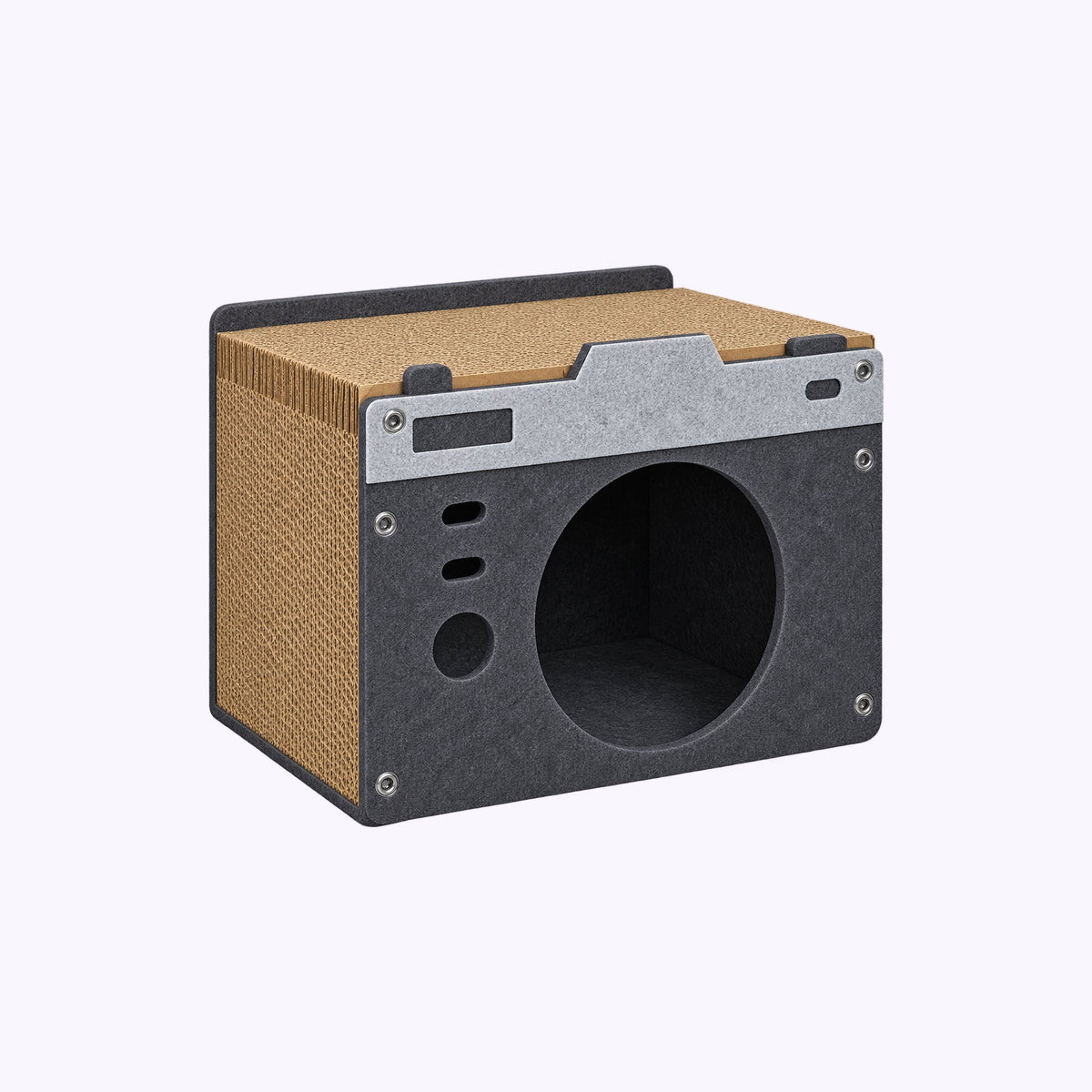
- PURRZ™ Catfluencer Cave. A camera-shaped den in corrugated cardboard and dark gray felt, with one round door at floor level and a corrugated cardboard roof and sides to scratch, "flute edges up". It measures 39.5 x 28.5 x 24 cm (16 x 11 x 9 in), weighs about 800 g (1.8 lb) and takes one cat curled up inside. The page is upfront that "It is a consumable: the roof frays, then goes through, and then it has done its job", and warns: "Never wet the cardboard: it swells and the roof goes soft."
- PURRZ™ Expand & Flex Toy. A corrugated cardboard scratcher you can "open it flat as a scratch pad, curve it into an arc to scratch and hide under, or join the magnetic end caps into a ring with a loose bell ball in its bed-shaped middle". The Single folds to 12 x 11 x 8.5 cm (5 x 4 x 3 in), and the page says it is "made from recycled board that goes back in the recycling". Its end caps hold small magnets, and the page says to "bin a scratcher whose cap has been chewed open".
- PURRZ™ Giant Cat Tunnel, Scratcher Lounge and Wool Ball Set. A bigger cardboard option: an open-ended tunnel in double-wall corrugated cardboard, 60 x 34 cm (24 x 13 in) inside and 39.5 cm (16 in) high, with a scratcher lounge beside it. The page says "Shreds are the product working."
FAQs
Why does my cat prefer the box to the bed?
A box gives your cat walls on three sides, a roof and a view of the door, which is exactly what a cat looks for in a safe spot. It's also new and it smells interesting. A cardboard cat house gives them the same things in a sturdier, nicer-looking package.
Is it normal for my cat to shred their cardboard house?
Completely. Scratching keeps claws in shape and leaves your cat's scent behind, and cardboard is made to take it. Vacuum the shreds and keep an eye out for actual eating, which isn't normal.
How do I clean a cardboard cat house?
Vacuum the shreds and loose fur, lint-roll any felt parts and wipe felt with a barely damp cloth. Never wet the cardboard itself. If it gets soiled, it's time to replace it.
Are cardboard cat houses good for kittens?
Kittens love them for hiding and pouncing. Keep an eye on small parts like bells, balls and caps until you know your kitten chases them rather than chews them.
Keep going
A cardboard cat house is simple fun in the best sense: a den, a scratcher and a stage all in one. Put it where your cat already scratches, keep it dry, let them shred it, and replace it when it's done. Your couch will thank you.
For more on why cats love boxes, how to set one up safely and when hiding means a vet visit, read Why Do Cats Like Boxes? on ASK A VET™.